
2026 Programming
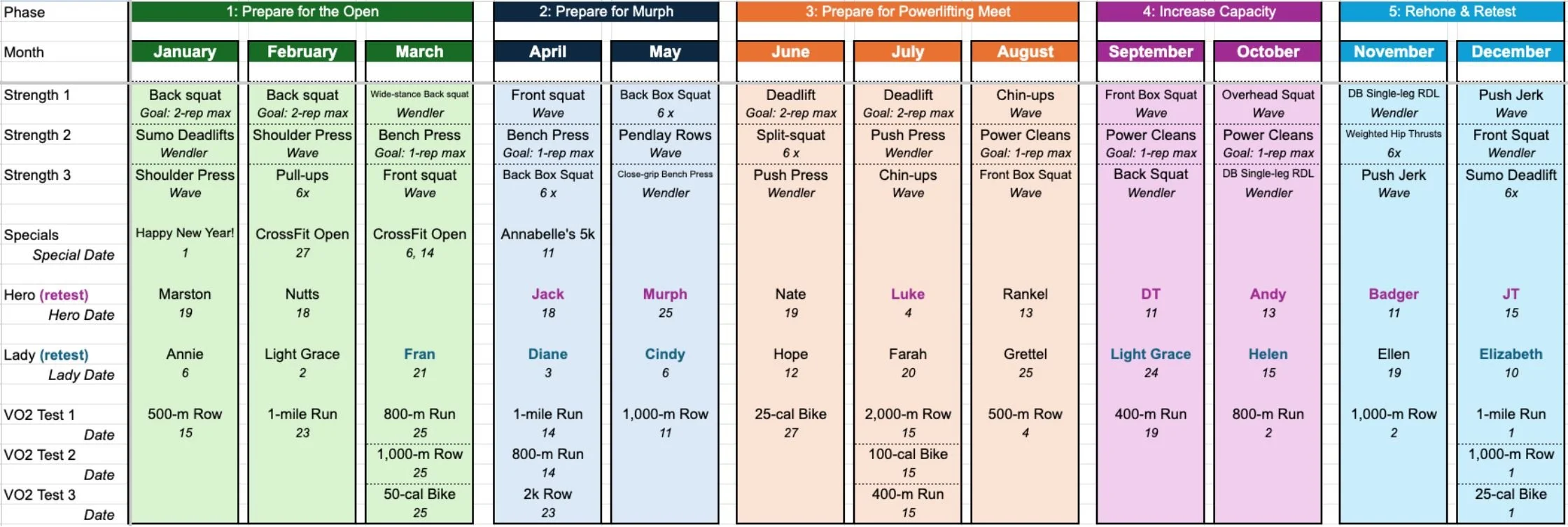
Here’s the big picture of our 2026 programming plan.
This year is built around one simple goal: help you live longer and feel better while you’re doing it. That means getting stronger, building muscle, improving your VO2 max, burning fat, and stacking years of healthy life on the back end.
The entire year is organized into clear phases, each with a purpose. We start by preparing for the CrossFit Open, sharpening skills and testing strength under pressure. From there, we shift toward Murph prep, building durability, aerobic capacity, and grit. Summer focuses on pure strength with a powerlifting emphasis, giving you time under heavier loads to drive muscle growth and bone density. Fall increases overall capacity, blending strength, power, and conditioning. We finish the year by re-honing skills, retesting key benchmarks, and setting the stage for the next cycle.
Throughout the year, we deliberately train the two most important predictors of lifespan and healthspan: lean mass and VO2 max. Lean mass means muscle and bone density. It protects your joints, stabilizes blood sugar, supports hormones, and keeps you independent as you age. VO2 max reflects how well your heart, lungs, and muscles work together. It is one of the strongest indicators of long-term health and resilience.
This is not random workouts. It is intentional, progressive, and coached. Train with us in 2026, and you will get stronger, fitter, and more capable for life outside the gym, not just inside it.
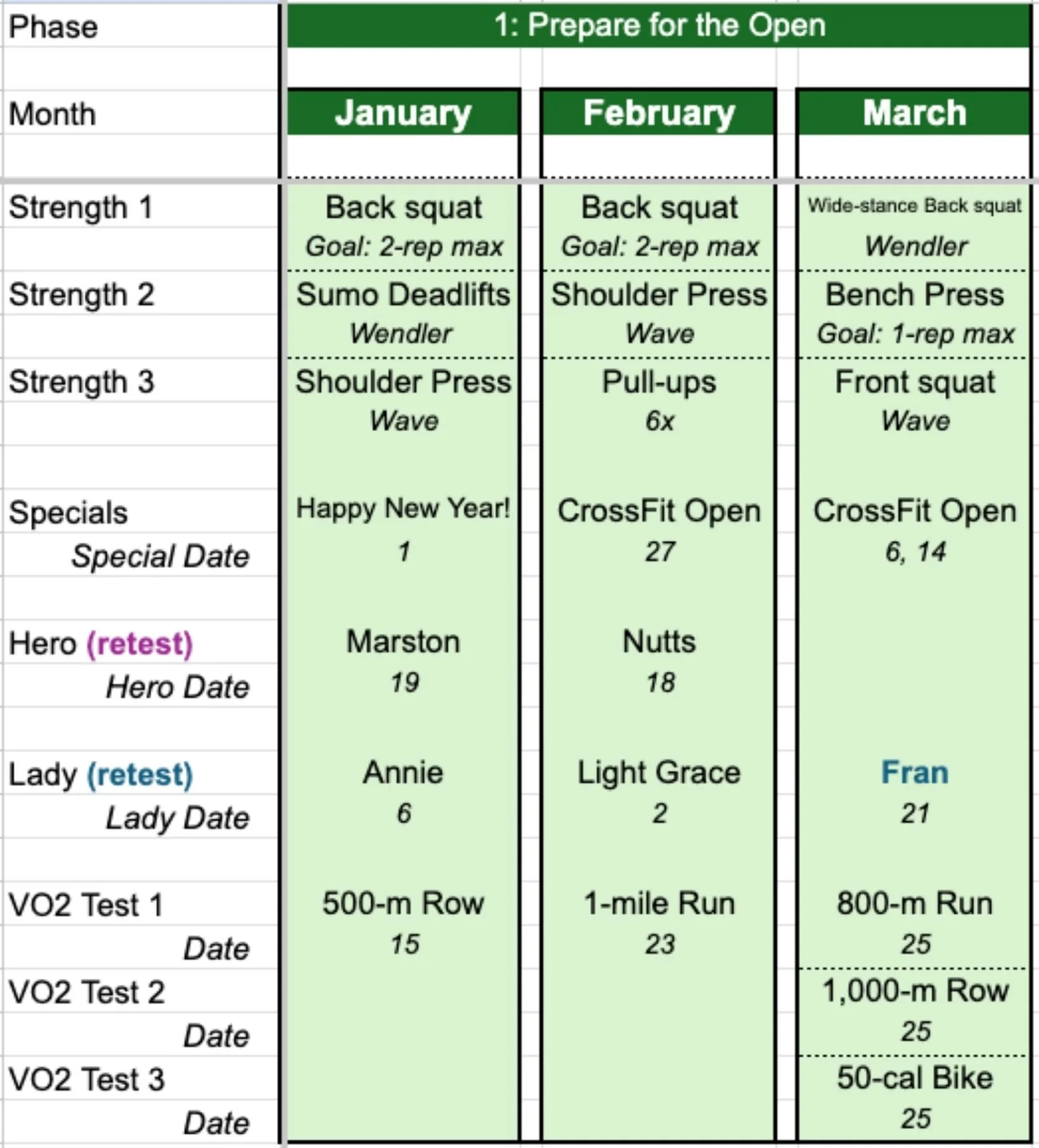
Phase 1: Prepare for the CrossFit Open
Phase 1 is all about sharpening the tools that actually show up in the CrossFit Open. January through March is where we build strength, practice key movements, and test conditioning in a way that feels familiar when the Open arrives.
Strength work is deliberate and heavy. We focus on back squats, front squats, bench press, shoulder press, and sumo deadlifts using proven wave and Wendler-style progressions. You will see clear strength goals like building toward a heavy 2-rep max on squats and testing a 1-rep max on the bench. This is how we protect lean mass, improve bone density, and make everyday workouts feel easier.
Gymnastics volume is simple and repeatable. Pull-ups show up consistently with structured sets so athletes build confidence, capacity, and efficiency without burning out. These are the exact skills that tend to limit people in the Open, so we train them calmly and often.
Conditioning is tested, not guessed. Each month includes VO2-focused benchmarks like a 500-meter row, 1-mile run, 800-meter run, 1,000-meter row, and bike tests. These efforts are short, honest, and repeatable, giving us real data on aerobic fitness. Improving these numbers directly improves VO2 max, one of the strongest predictors of long-term health.
We also retest classic CrossFit benchmarks like Annie, Light Grace, Fran, and Hero workouts like Marston and Nutts. These workouts tell us if strength, skill, and engine are actually improving.
Phase 1 sets the tone for the year. Stronger legs, stronger presses, better lungs, and the confidence to walk into the Open prepared, not hoping.
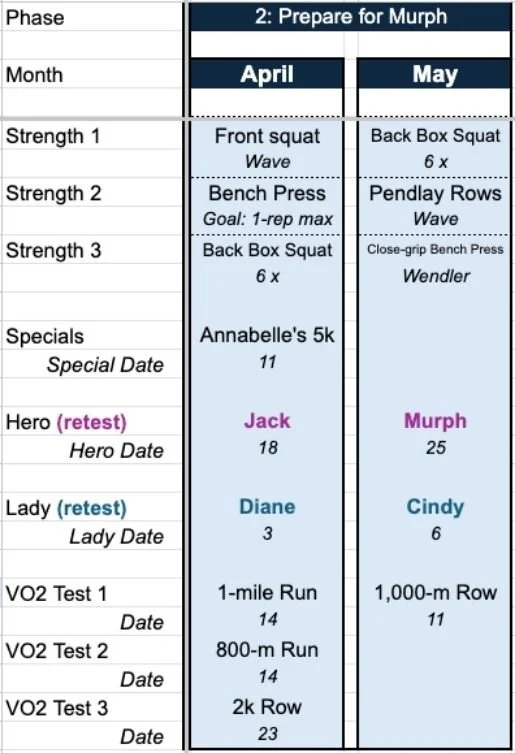
Phase 2: Prepare for Murph
Phase 2 shifts the focus from testing to durability. April and May are about earning the right to do Murph well, not just surviving it.
Strength work supports high-rep bodyweight volume and long efforts. Front squats and back box squats build leg stamina and positional strength so running and air squats stay efficient late in workouts. Bench press and close-grip bench press strengthen pressing endurance for push-ups, while Pendlay rows balance the shoulders and protect them under high pull-up volume. These lifts are trained with waves, 6x schemes, and Wendler progressions so strength improves without unnecessary fatigue.
Running and rowing take center stage. VO2 tests include 1-mile runs, 800-meter runs, 2k rows, and a 1,000-meter row. These efforts are long enough to stress the aerobic system and short enough to push pace. Improving these numbers directly raises VO2 max, which is critical for Murph and for long-term heart health.
Benchmark workouts are chosen on purpose. Diane and Cindy reinforce hinge strength, pressing stamina, and pull-up efficiency. Jack and Murph itself anchor the phase, giving athletes exposure to high-volume movements under fatigue while maintaining structure and pacing.
Annabelle’s 5k adds mental toughness and steady-state aerobic work, teaching athletes how to stay composed when discomfort lingers.
Phase 2 is about building an engine that does not quit and a body that can handle volume. Strong legs, durable shoulders, better lungs, and smarter pacing. When Murph arrives, you are prepared, not guessing.
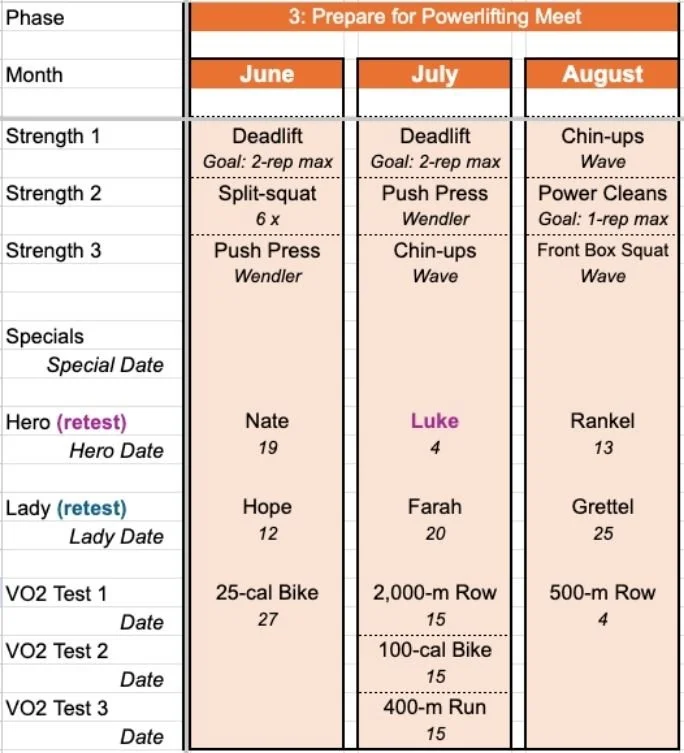
Phase 3: Prepare for the Powerlifting Meet
Phase 3 is where absolute strength takes center stage. June through August are designed to build muscle, reinforce sound lifting mechanics, and prepare athletes to express strength confidently under heavy loads.
The backbone of this phase is the deadlift. June and July drive toward a heavy 2-rep max, using progressive loading that rewards patience and consistency. Split squats appear in high-volume 6x schemes to build unilateral leg strength, improve knee and hip stability, and add muscle where most people are weak. Push press follows a Wendler progression to develop powerful overhead strength and transfer force from the lower body to the upper body, while reinforcing bracing and timing.
Chin-ups stay in the plan through structured waves. Heavy pulling volume balances pressing work, supports shoulder health, and continues to build lean mass in the upper body. In August, power cleans move toward a tested 1-rep max, sharpening bar speed and reinforcing efficient pulling mechanics that carry over to the deadlift. Front box squats round out the phase, building positional leg strength and confidence at depth.
Conditioning does not disappear. VO2 tests rotate through bike sprints, longer rows, and short runs. These efforts maintain aerobic capacity and work tolerance without interfering with strength gains.
Benchmarks like Nate, Luke, Rankel, Hope, Farah, and Grettel add grit and volume under fatigue, ensuring strength translates to real work, not just numbers on a bar.
Phase 3 builds muscle, bone density, and confidence. By the end of summer, athletes are stronger, more resilient, and ready to step into a powerlifting meet feeling prepared and capable.
Phase 4: Increase Capacity
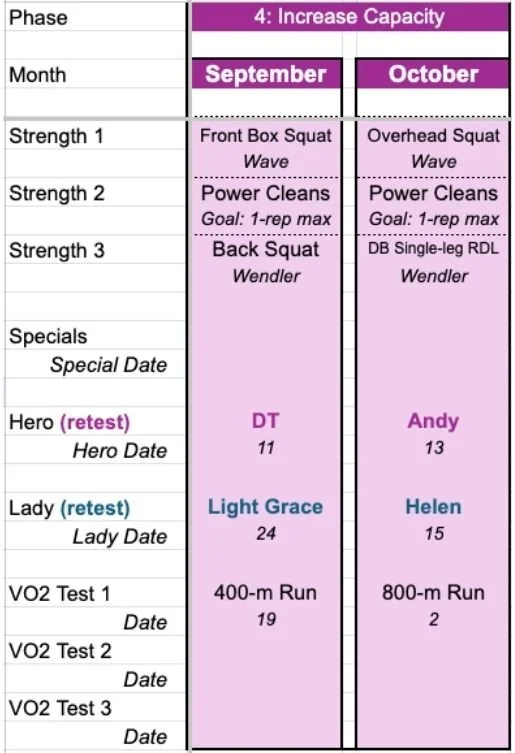
Phase 4 is where strength and conditioning collide. September and October are designed to raise the ceiling on how much work you can do while staying strong, fast, and technically sound.
Strength training shifts toward positions that demand control under fatigue. Front box squats and overhead squats are trained in wave progressions, reinforcing posture, mobility, and midline stability. These lifts force precision. You cannot hide weak positions when the load and volume increase. Back squats continue on a Wendler progression to maintain absolute strength while capacity rises.
Power cleans are a major driver of this phase. We build toward a tested 1-rep max in both September and October, focusing on bar speed, timing, and repeatability. In October, dumbbell single-leg RDLs are added with a Wendler-style progression to challenge balance, posterior chain strength, and unilateral control, all while accumulating meaningful muscle-building volume.
Conditioning becomes sharper and faster. VO2 testing centers on the 400-meter and 800-meter run. These distances sit right in the uncomfortable middle, long enough to demand aerobic efficiency and short enough to punish poor pacing. Improving these times means your engine is getting bigger and more efficient.
Benchmark workouts reinforce the theme. DT and Andy demand heavy barbell cycling under fatigue. Light Grace and Helen test speed, power, and composure when breathing is elevated.
Phase 4 teaches you to do more without breaking down. You lift heavy, move well, and recover faster between efforts. Capacity goes up, confidence follows, and everyday workouts start to feel manageable again.
Phase 5: Rehone and Retest
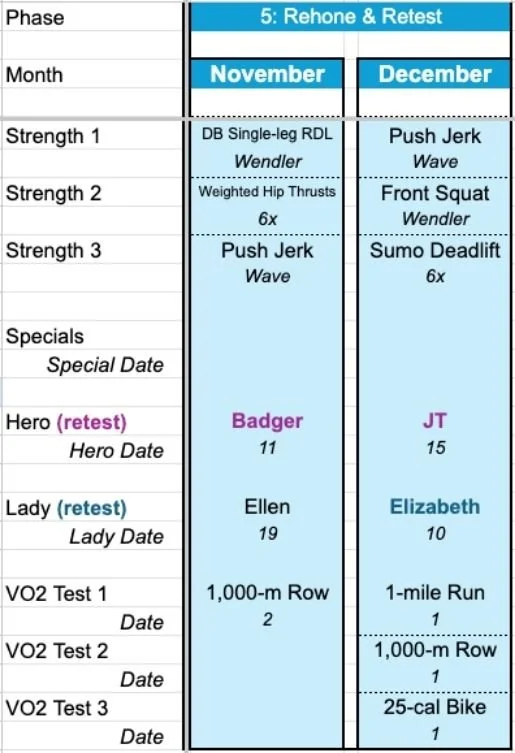
Phase 5 is where the year comes full circle. November and December are about refining movement, restoring balance, and retesting the things that matter most.
Strength work emphasizes quality and confidence. Dumbbell single-leg RDLs follow a Wendler progression to reinforce unilateral strength, balance, and posterior-chain integrity. Weighted hip thrusts in 6x schemes rebuild glute strength and hip extension power without excessive spinal loading. Push jerks return in structured waves, sharpening timing, coordination, and overhead stability. Front squats and sumo deadlifts anchor December, using Wendler and 6x progressions to retest lower-body strength and reinforce strong positions under load.
Conditioning benchmarks return with intent. VO2 tests include a 1,000-meter row, a 1-mile run, and a short bike test. These repeat efforts from earlier in the year, giving us clean data on how aerobic capacity has changed. Better times here reflect a higher VO2 max and a more efficient engine.
Classic workouts close the year. Badger and JT demand grit, pacing, and technical discipline under fatigue. Ellen and Elizabeth retest speed, pulling endurance, and barbell cycling efficiency. These workouts are familiar, honest, and revealing.
Phase 5 is not about chasing new skills. It is about sharpening the ones you have built all year. Stronger lifts, better conditioning, cleaner movement, and clear proof of progress. You finish the year fitter than you started and ready to repeat the process smarter, stronger, and healthier.